A Choreography of Light, Layers, and Connectivity Beneath the Rain Trees
Bayshore Station, part of Singapore’s Thomson–East Coast Line, is an underground Mass Rapid Transit (MRT) station designed to cater to a growing residential district and a future park — while being seamlessly linked to East Coast Park via a landscaped pedestrian bridge. In keeping with the Line’s overarching design theme, “A Sense of Place”, the station’s architecture was conceived as a dialogue with its context. Each entrance draws upon the vernacular of its surroundings and adopts their architectural language.
-
Completed
2024
-
Location
Bayshore, Singapore
-
Floor Area
21,721 sqm
-
Client
Land Transport Authority
Bayshore Station won Project of the Year (Infrastructure) at the BCA Awards 2025 for its collaborative planning and innovative construction.
-
Design Intent
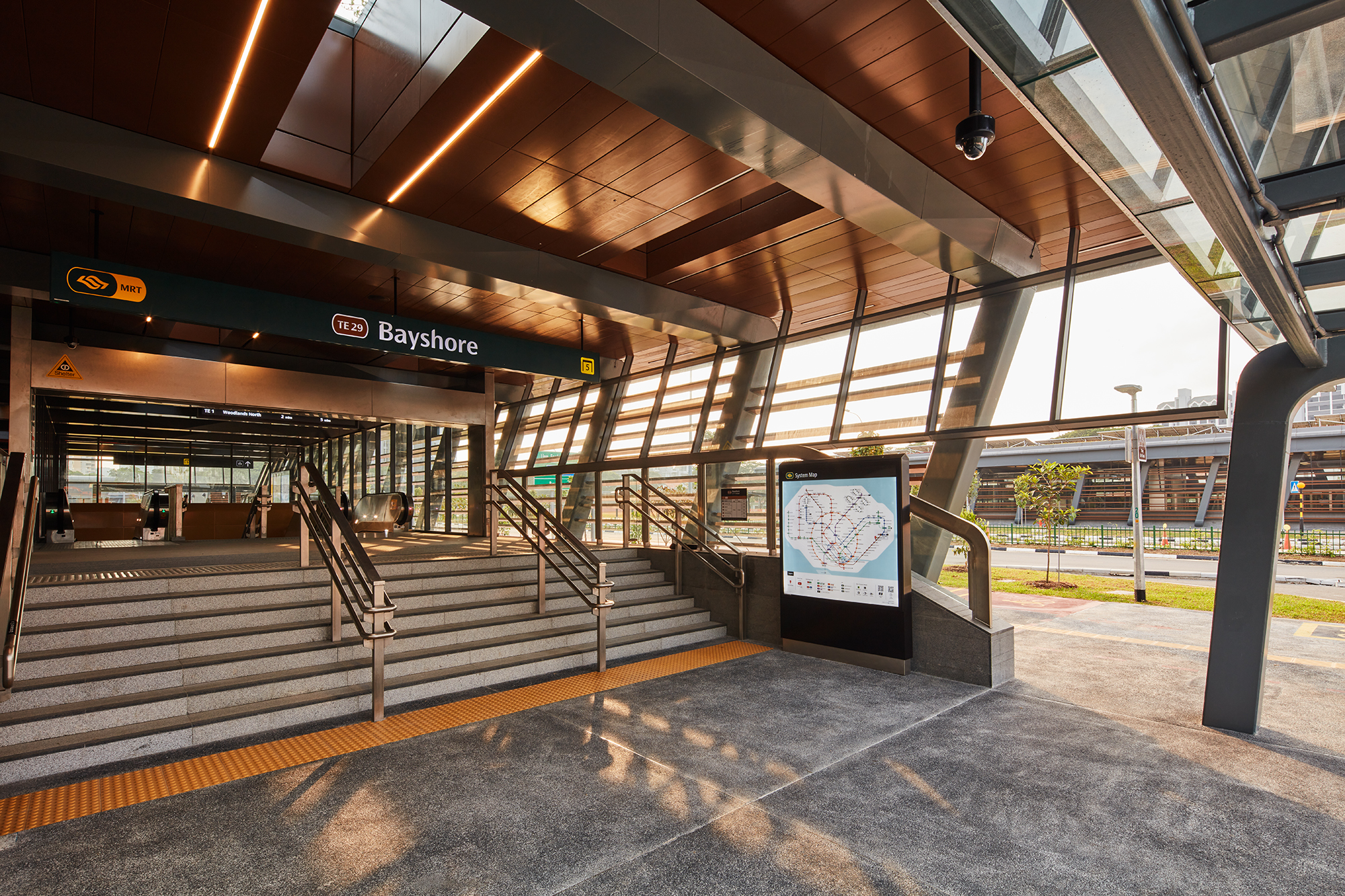
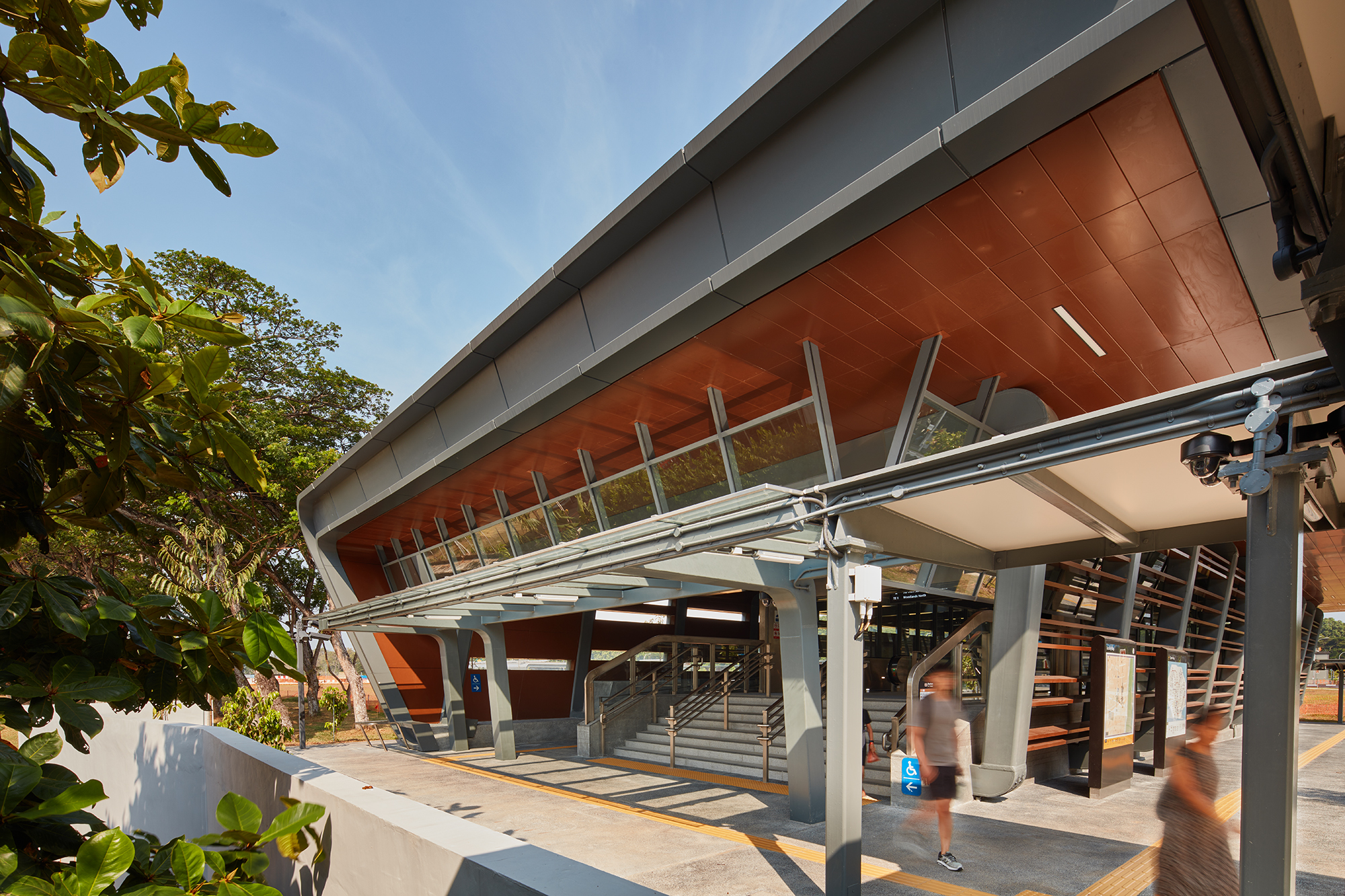
Bayshore Station’s entrances were designed to blend with the neatly manicured boulevard of existing rain trees with wide canopies that border the East Coast Park Expressway and create a dappled sunlight effect through their leaves. Using a weave of perforated panels and horizontally-slatted screens, they allow natural light to pass through, conveying visual lightness and spatial openness. These linear lines also create a sense of movement that alludes to the speed of the trains running below ground.
To address space limitations, Bayshore Station adopted a stacked track alignment within the narrow corridor threading through back lanes of residential developments between Bedok South Avenue 1 and Bayshore Road.
-
The entrance’s roof is supported by a colonnade of branch-like columns that line up with the rows of rain trees. The rich composition of different materials at the entrances also echoes the layers in the canopies’ foliage.
-
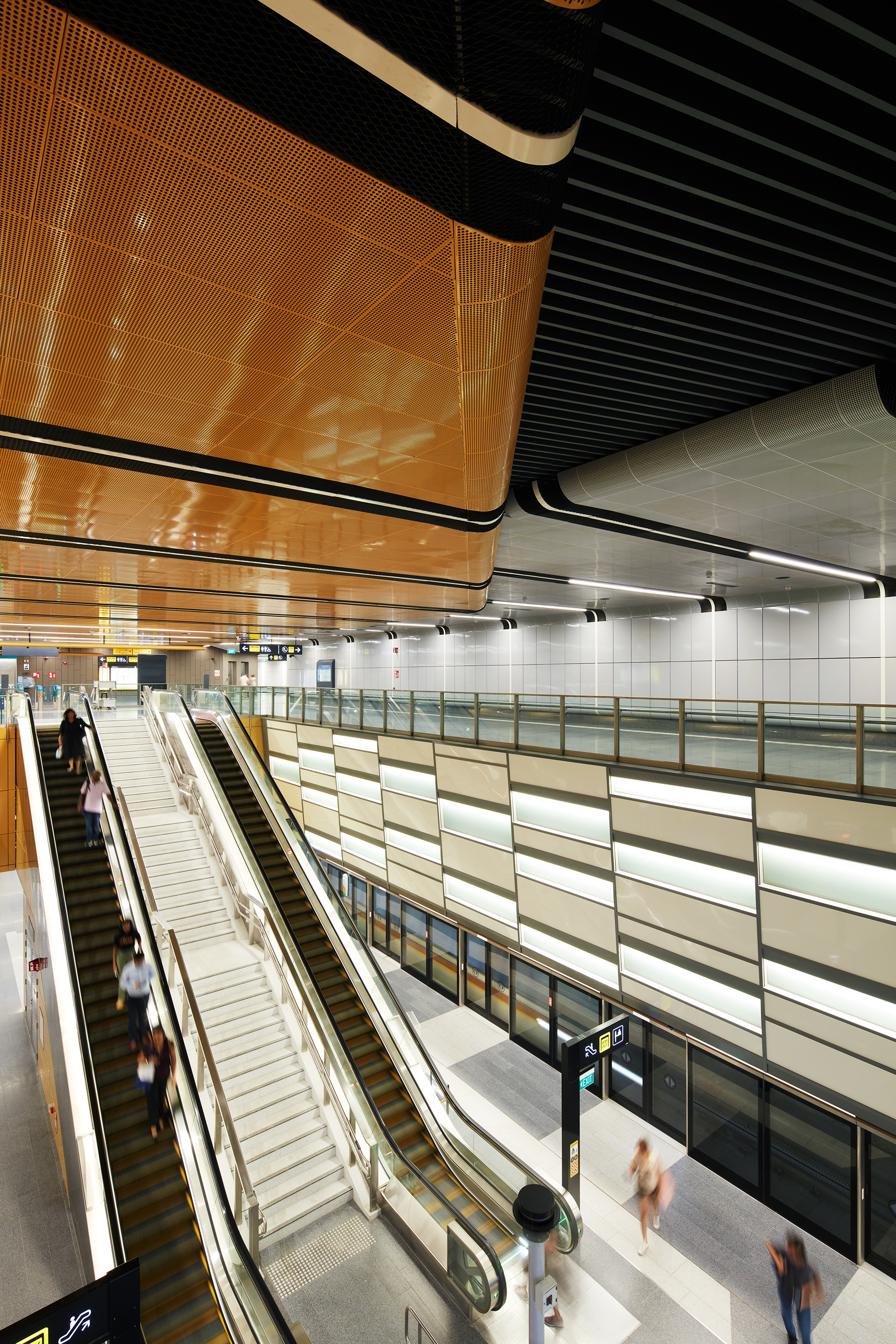
This layering effect continues underground to the concourse and platform levels, enveloping commuters to provide a personable scale against the tall station volume.
-
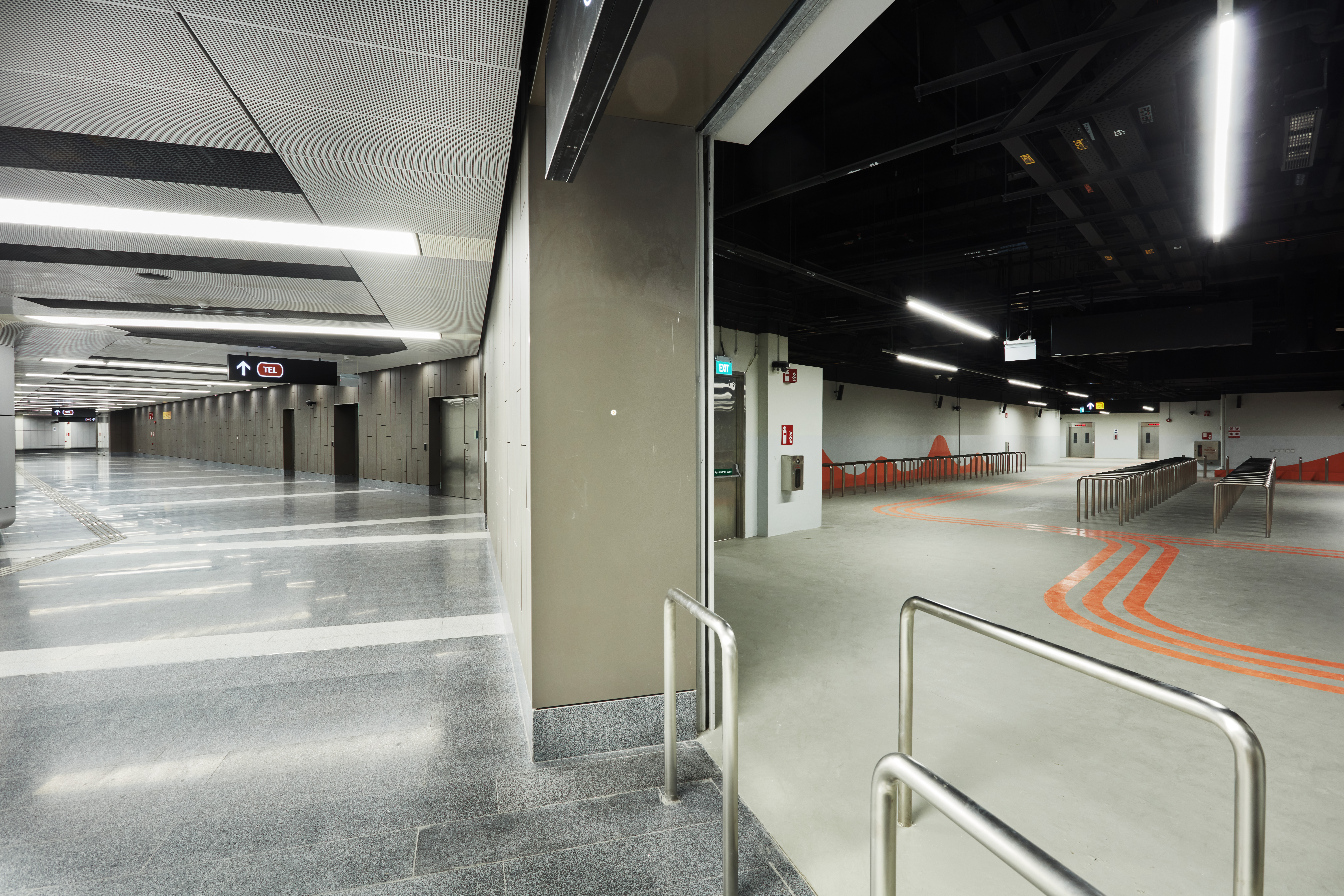
In line with the precinct’s car-free vision, Bayshore is among the first few stations in Singapore to have underground bicycle parking.
Studio Dialogue
with Rustam Tan, Executive Director, SAA Architects
Lead for Transport Sector
What was the design intent behind Bayshore Station?
The surrounding site is lined with rows of mature rain trees, whose canopies cast intricate patterns of light and shadow on the ground. It was this ephemeral experience of Komorebi that became the starting point for our design approach.
We envisioned the entrances of Bayshore Station as open pavilions, where light filters through the porous structure to recreate the experience of walking beneath canopies. Perforated screens along the façade and skylights further echo the visual permeability of foliage, allowing not just light but air to pass through for natural ventilation.
What were some strategies employed in the design of Bayshore and other MRT stations to elevate the commuter experience?
Beyond circulation and efficiency, colour plays a pivotal role in elevating the commuting experience. Calming shades of blue ease anxiety, while bold accents — such as the vibrant red at Orchard Station —inject energy and dynamism. At Orchard Boulevard Station, which connects directly to Camden Medical and welcomes a high volume of outpatients, a clean, neutral palette was chosen to evoke calmness and support the healing process.
Spatial strategies further enhance this experience. Double-volume spaces and overlooking pathways create a sense of expansiveness, generosity, and welcome within subterranean settings. Skylights, strategically introduced at stations like Orchard Boulevard, bring in natural daylight, offering moments of respite amid the busy transit flows.
How has the design of MRT stations evolved from earlier generations?
Earlier train stations prioritised efficiency and practicality, often with amenities such as retail spaces kept to a minimum. Today, evolving societal needs have made way for newer MRT stations to serve as multi-functional civic anchors. More stations are being conceived as part of broader Transit-Oriented Developments, integrating transport hubs with residential, commercial, and community amenities, creating new urban lifestyle nodes that augment the transiting experience of station spaces.
Moreover, each station is increasingly responsive to its surrounding context and identity. Bayshore Station, for instance, serves a precinct that encourages car-lite mobility. Hence, it includes a 300-capacity underground bicycle park to strengthen first-and last-mile connectivity.
“Looking ahead, the team is exploring multisensory design interventions, such as infusing subtle scents through theair-conditioning system. This adds a layer of sensory design and promotes a more tranquil and relaxing commuting experience.”